
Good morning everyone,
don’t let other people’s limitations hold you back just because their map isn’t big enough for your goals and dreams. I recently wrote a post on Substack inspired by another post about limitations in your mind. I think it was by Gary Vee. It got me thinking because many people let others’ limitations limit themselves.
What do I mean?
I dropped out of school at 17. At the time, I had the feeling that I was ‘too dumb’ and that everyone else was smarter than me. I started an apprenticeship, but two months in, I decided I wanted to finish my high school diploma as well; my goal was to complete the apprenticeship and graduate simultaneously.
My ‘bigger why’ was that I wanted to study law and earn a degree. One day, the foreman on the construction site heard about my plans. During a break, he asked me what I wanted to be when I ‘grew up.’ When I told him I wanted a law degree, he laughed loudly. He said it was a pretty big goal for someone who had just dropped out of school. To him, it was unimaginable that a dropout could dream of becoming a lawyer. But to me, it was clear that I would achieve it—even though I knew it would be a long, tough journey.
Years later, I did achieve it because I had resilience, a goal, and my why. My advice is not to let others’ limitations affect you because everyone has their own map. Others’ maps might be smaller or bigger than yours, but that’s not the point. The key is knowing you can expand your own map. If you set a goal and truly want it, you can reach it.
One crucial thing is inner belief.
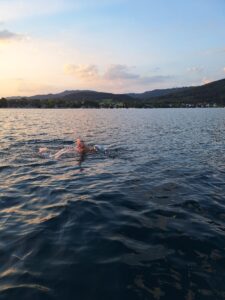
You must believe you can achieve your goal. When people heard I wanted to swim 65 kilometers across Lake Constance (65km), they thought I was crazy and said it was impossible. The same happened when I aimed to win my 10th water polo league title during my cancer diagnosis; they said it couldn’t be done. It wasn’t on their maps.
If you’ve set a goal but lack inner belief, my simple tip is the 5 Whys method. Ask yourself five times why you want to achieve this goal and what’s important behind it. You’ll find that it’s not just the goal but also the why that’s crucial.
The 5 Whys of Lake Constance
Why do you want to swim the 65km length of Lake Constance?
Because it is an extreme endurance challenge that very few people in the world have ever completed. (In fact, only eight people have ever succeeded, and I was proud to become the sixth.)
Why is it important to be one of the few to achieve this?
I want to show my children that no matter where you start—even as a school dropout or someone facing a crisis—big, “impossible” goals are achievable if you have the right mindset.
Why is it important to set that example for your children and others?
Because during my cancer therapy, I witnessed firsthand that people with clear goals handle the struggle of treatment much stronger (not better – but this is another story); they focus on a destination beyond the illness rather than the pain of the present.
Why does the connection between goals and illness matter so much to you?
As an ex-cancer patient and a former national team captain, I know that the hardest “games” are won in the mind. I want to prove that a diagnosis is not a finish line, but a reason to find a new, bigger map.
Why is this your ultimate mission? (The Root Why)
My mission is to raise awareness for people living with an illnesses.
So from wanting to swim across Lake Constance, my real why emerged: raising awareness for those living with illness. This why was much stronger than the initial goal and kept me going even when things got tough.
There are many ways to work on inner belief, but one small tip from project management is the 5 Whys method. Ask yourself why five times, and you’ll be surprised at what you discover.
The Takeaway:
We all carry a map of what we believe is possible. Some maps are small, cramped by fear and convention; others are vast, expanded by resilience and ambition. The foreman’s laughter wasn’t a reflection of your ability—it was a reflection of the smallness of his own map.
Remember: You are the cartographer of your own life. If your goal feels too big for your current map, don’t shrink the goal—expand the map. Use your “Why” as the compass that guides you into the “impossible” territory.
My Tool: The “Life GPS” Method
Think of it this way: Your Goal is the destination you enter into your GPS. If you want to drive to Paris, you must enter the exact address. Once the destination is set, you simply start driving.
When you hit a traffic jam or a road closure (the “Foremen” or life’s setbacks), your internal GPS will automatically recalculate. It will find a new route because the destination is locked in.
Define the Address: Don’t just say “I want to be successful.” Be specific. “65km across Lake Constance” is a precise address.
Hit “Start”: The GPS doesn’t work if the car is in park. You must move to get directions.
Trust the Recalculation: Obstacles aren’t signs to turn back; they are just prompts to find a different road to the same destination/goal.
Whether you are leading a team through a market crash or leading yourself through a life-altering illness, the rules are the same:
Don’t let a ‘Foreman’s Map’ dictate your team’s destination. Set the GPS, find your Root Why, and start driving.
All the best,
Bernhard
P.S. I’m currently on a multi-year journey to swim The Alpine Seven—339 km across seven iconic lakes—to prove that our maps are always bigger than we think. If you want to join me as I navigate these waters and share what I learn about leadership, resilience, and turning “impossible” goals into reality, hit the button below.
Subscribe for more reflections on leadership, crisis, and building a life where “impossible” goals become a side-effect!
P.P.S. I plan to send this out every Friday morning 5am CET. But as this is a human-to-human connection, please bear with me if life (or my kids) decides to “reorganize” my schedule. I’m a pretty good swimmer, but I haven’t figured out how to swim through a family emergency at a good speed yet! 😉