
“How can I achieve this? Am I crazy? Damn it, there’s no way I will reach this goal. No way I did it again!”
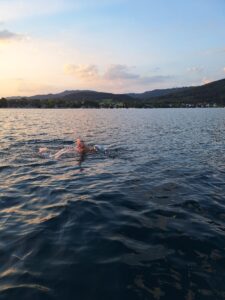
These were the thoughts running through my head when I announced that I wanted to be the first Austrian to swim the entire 65-kilometer length of Lake Constance. That’s 65 kilometers non-stop, without a wetsuit, in cold water and swimming for a full day and night.
Once again, I’d bitten off more than I could chew. Again! To make matters worse, everyone said it couldn’t be done; the goal was too big. It wasn’t exactly the best start for building confidence. And they weren’t entirely wrong—it was a massive goal that required ten months of hardcore preparation and dedication.
But how can you stay focused on that kind of goal? Especially during the chaos of our daily lives (family, kids, job, career…)? And for so long?
I assume that everyone has set themselves a goal so big that it scared them—and then failed to achieve it. Let´s be honest we have even failed at smaller goals. Just think about the classic New Year’s resolutions.
Did they ever survive February?
The toughest part isn’t finding the goal. The hardest part is breaking that BHAG (Big Hairy Audacious Goal) into steps that actually fit into our daily lives.
But every big goal can be achieved! Just think about Dashrath Manjhi, who carved a path through a ridge of hills using only a hammer and a chisel. Reading that, we don’t have any more excuses, or! Haha…
There is a solution for how we can dream big and break that goal into daily, actionable steps. Honestly, I thought everyone knew this. But during a senior management training, when I presented it, nobody did. That confused me. So I thought maybe this is only well known in the sports world. I talked to some athletes—and got the same result. Nobody knew it.
The Harada Method
The solution is called the Harada Method and gained attention in the sports world when Shohei Othani was linked to it. If you don’t know him, he is the Michael Jordan or Tiger Woods of baseball. He has changed the game of Baseball. Just look at his impressive records, all listed on Wikipedia.
As a teenager, he had the goal of being the #1 draft pick in the Nippon Professional Baseball league. A huge goal!
At the time, it seemed unattainable. Fortunately, he discovered and used the Harada Method.
To be honest, the Harada Method is quite simple. It places a big goal at the center. Then, you break that goal into 8 topics, and those 8 topics into 8 daily actions/habits.
Shohei broke his goal down into small daily habits that could be implemented consistently, allowing him to maintain his vision while focusing on the task at hand. Just google “Shohei Othani Harada Chart” and you will see multiple images of his Harada Chart.
I did exactly the same for Lake Constance. I wrote down my big goal—swimming across the lake—and identified eight topics like nutrition, recovery, training and so on. Then I broke each of these down into eight small habits. It worked because I had a method I could apply every day. Screenshot below:
Adapting the Framework
In hindsight, 64 daily steps were a bit too much for me. As you can see in my Harada chart (above), I didn’t set eight actions for every single topic—but it still worked. For my next challenges—Lago Maggiore (66km) in June, Lake Lucerne (39km) in July, and Lago di Garda (59km) in September—I simplified things.
I kept the big goal at the center but chose just four main topics, breaking them down into also just four actionable steps each. Now I’m down to 16 manageable steps. The original 64 steps were a bit overwhelming, especially during a crisis or a busy business season.
But that is exactly why tools and frameworks exist. We get inspiration and adapt them to our needs. Sixteen is a doable number for me. Any leader, athlete, or person in a crisis can adopt this approach because it’s practical and actionable.
In my book—launching in early summer—the Harada Method is a core part of my SWIM Method
Self-Leadership
Why (the Harada Method sits here)
Inner Belief
Momentum
Try it yourself
What is our BHAG (Big Hairy Audacious Goal)?
If you want to use this for yourself, take a piece of paper and write your goal in the center. Then, divide the page into the number of topics you need and enter the daily tasks below each topic.
In case you don’t feel “creative” enough or simply hate drawing, here is a link to my template. I have created this for you, so feel free to use it and share it!
Hope the Harada Method helps you as much as it has helped me. Let me know your experience.
All the best,
Bernhard
P.S. I’m currently on a multi-year journey to swim The Alpine Seven—339 km across seven iconic lakes—to raise awareness for people living with an illness and to prove that even impossible goals can be achieved with the right system in place. If you want to follow the journey and read my reflections during my time in the water—which is a lot of time—hit the button below.
Subscribe for more reflections on building a life where “impossible” goals become a side effect!
P.P.S. I plan to send this out every Friday morning 5 am CET. But as this is a human-to-human connection, please bear with me if life (or my kids) decides to “reorganize” my schedule. I’m a pretty good swimmer, but I haven’t figured out how to swim through a family emergency at a good speed yet! 😉